Musical Creativity and Expression: Composing and Improvising in Primary
By Pete Jenkins6 min read
Updated
Musical creativity and expression can sound like big words for a wet Tuesday afternoon. In a primary classroom they come down to two things: composing, which is making music up and keeping it, and improvising, which is making it up on the spot. Neither needs notation or a specialist. What both need is limits. 'Make up anything you like' usually ends in noise or a blank look, while 'make up four beats using these words' gets nearly everyone started. The four tasks below all work that way.
A four-beat rhythm composition
We'd start every class's composing here. It takes about 30 minutes and needs nothing but a board.
- Warm up with echo clapping (5 minutes). Clap a four-beat pattern and the class claps it back. Keep a steady pulse going with your foot so the patterns line up.
- Turn words into rhythms (5 minutes). Pick a topic, say food, and collect words with different rhythms: 'chips', 'pizza', 'macaroni'. Say each one on the pulse, then clap it as you say it.
- Compose (10 minutes). Draw four boxes on the board and tell the class: 'Each box is one beat. Put one word in each box. You can use a word twice, and you can leave a box empty for a silent beat.' Pairs choose their four words, write them in four boxes and practise saying and clapping them.
- Perform (10 minutes). Each pair performs their pattern twice and the class echoes it back. Then ask: 'Which box had the most sounds in it?'
In KS1, compose one pattern together as a class first, use picture cards instead of written words, and play it with stamps, pats and claps. In KS2, swap the words for untuned percussion once the pattern is secure and write it down in rhythm notation ('chips' is a crotchet, 'pizza' is two quavers). It's the same idea as the Model Music Curriculum's Year 4 task of arranging note cards into 2, 3 or 4-beat phrases. Then put two pairs together: one plays while the other rests, then both at once.
Two things go wrong. Everyone practises at once and the room gets loud, so make practice 'whisper clapping' (two fingers on a palm) and save full volume for performing. And some pairs can't agree, so let each child choose two of the four boxes.
Graphic scores: music you can draw
A graphic score uses pictures and shapes instead of notes. The Model Music Curriculum suggests KS1 children learn that graphic notation can stand for the sounds they've made, and invent their own symbols. It works just as well in KS2.
Hand out four instruments: say a shaker, a drum, a triangle and a glockenspiel. Ask the class to invent a symbol for how each one sounds, such as dots for the shaker, a big circle for the drum and a zigzag for a glockenspiel run. Draw a long strip on the board, read from left to right, and place symbols along it. Point along the strip like a conductor, and each player plays their symbol as you reach it. Bigger symbols mean louder. A gap means silence.
Once they've got it, groups write their own strip on A3 paper and swap with another group, who have to play it with no help. That's the real test: if the other group can't read it, the symbols aren't clear yet. In KS2, look up Cathy Berberian's Stripsody (1966), a piece for solo voice written like a comic strip and full of cartoon sound effects. A page of it on the board shows how far the idea can go. For more ways to make music visible, see a multi-sensory approach to music lessons.
Pentatonic improvising on glockenspiels
Take the F and B bars off every glockenspiel. What's left is C, D, E, G and A, a pentatonic scale, the same one the Model Music Curriculum uses in its KS2 examples. Those notes rarely clash, so children who freeze at the word 'improvise' suddenly have very little they can get wrong.
- Set up a steady background (3 minutes). You, or a confident child, play C and G together on a steady beat, on a bass xylophone or two chime bars. This drone keeps everyone anchored.
- Question and answer (10 minutes). Play four beats on your glockenspiel, then point to a child, who answers with four beats of their own. Go round the circle without stopping the drone. Tell them: 'There's no wrong answer. Play four beats, then stop.'
- Finish on C (5 minutes). Point out that answers ending on C sound finished, and answers ending elsewhere sound like another question. Let children choose which they want.
- Pairs (10 minutes). One plays a question, the other answers, then they swap.
In KS1, start with just two bars, G and E (the cuckoo call), add A later, and answer with voices before instruments. In KS2, stretch answers to eight beats, swap the drone for a simple groove, and record a few so the class can hear them back. Expect some children to play the same thing every time at first. That's fine. Ask them to change one thing next time: the last note, or the rhythm.
Two practical points. Keep the F and B bars in a labelled envelope in the glockenspiel box, or they'll be gone by half term. And before anything else, teach a 'beaters down' signal: beaters on the floor, hands on knees. There's more on signals like this in classroom management during music lessons.
Musical creativity and expression: building on children's ideas
The quickest way to make children feel like composers is to treat their ideas as music. When a child plays or claps something interesting, even by accident, stop and use it.
- Repeat it: the whole class copies it, so it becomes the class's idea.
- Change one thing: play it quieter, then slower, then backwards.
- Layer it: half the class keeps it going while the other half adds something on top.
- Name it after the child who made it, and use that name next lesson.
Be specific when you praise. 'You left a silence before the last beat, and it made everyone wait' tells a child what worked; 'brilliant' doesn't. And if an idea doesn't come off, ask the child what they wanted it to sound like, then help them get there rather than fixing it for them.
To start this week, try the four-box rhythm composition: it needs a board and a topic. Our free Body Percussion Rhythms composition grid works the same way with stamps, pats and claps, the graphic score activity is ready to print for the second task, and our composition mood boards help when a class is stuck for ideas.
Resources to try
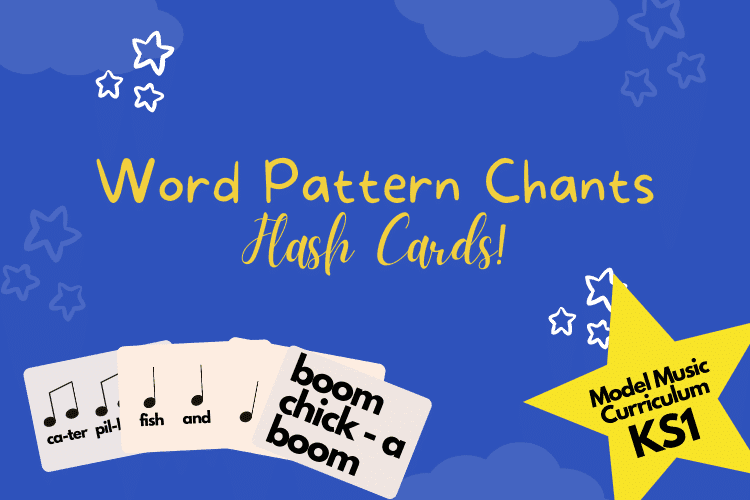
Musical Chants Flashcards: Fun Music Curriculum Resources KS1
Worksheets · Ages 0 to 7
Based on the KS1 Model Music Curriculum, these flashcards help your children practice the word pattern chants. Ready made for you to cut out and use exactly as you would like to in your classroom.
The Musical Alphabet: Secret Code
Worksheets · Ages 7 to 11
This resource helps you teach the musical alphabet, linking it to the normal alphabet your children already know.
Musical Elements: Easy KS2 PowerPoint Presentation
PowerPoint · Ages 7 to 11
Be confident explaining the musical elements to your KS2 class this term with this ready-to-go powerpoint presentation! With clear definitions for each one provided.
Pick A Door: Musical Instruments Game
PowerPoint · Ages 0 to 11
Make your lesson interactive with this musical instruments game. Go through the doors and name the instruments inside!